
Exclusive: Trump administration considers compelling US companies to reveal Chinese AI use
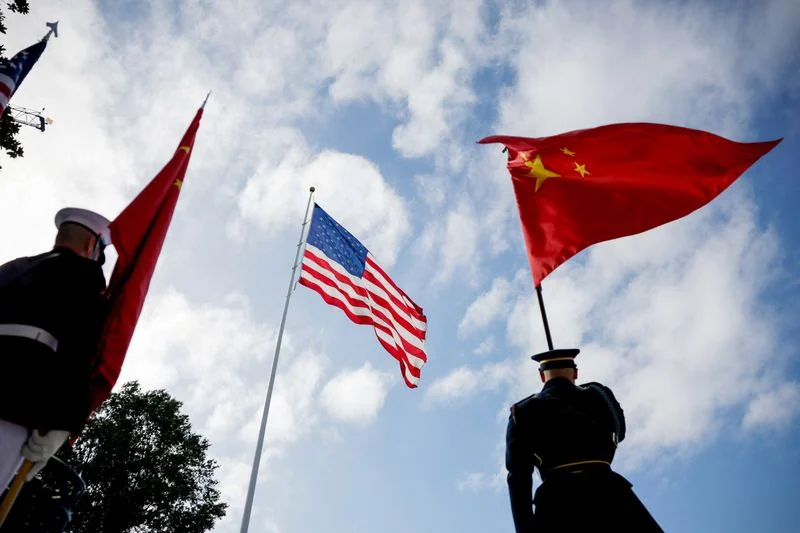
WASHINGTON, Nov 18 (Reuters) — Three people told Reuters that the Trump administration is weighing a requirement for U.S. companies to publicly reveal when they use Chinese AI models. The aim would be to discourage reliance on such technology without imposing fresh restrictions that could provoke industry or Beijing.
The Treasury Department and White House Office of Science and Technology Policy (OSTP) have discussed the proposal, which would cover firms including Airbnb, according to the people. Airbnb uses Qwen, an AI model developed by China’s Alibaba, to run its AI customer-service agent.
The plan would require companies such as Airbnb to publish that information on their websites.
It was not immediately clear whether the idea was gaining support inside the administration, or whether it would be formalized through rulemaking if it advances.
Reuters was first to report the discussions. Their consideration highlights a growing push within the administration to counter the spread of powerful Chinese open-weight models, which are a major concern for the government. Such models make core components publicly available for anyone to download and modify.
The proposal also indicates officials are exploring a “name and shame” approach to discourage Chinese AI use while maintaining a broader anti-regulation posture on AI.
The White House, Treasury and Alibaba did not respond to requests for comment. Airbnb said in a statement that its AI operations “run overwhelmingly on U.S.-origin models” and that it uses “only a limited number of China-origin models, all of which are open-source and run only through approved U.S.-based service providers, keeping data and operations separate and protected.”
The Chinese Embassy in Washington said Beijing opposes politicizing trade and technology issues, adding that doing so “will only stifle global AI advances and serve no one’s interests.” It also said: “We will resolutely safeguard Chinese businesses’ lawful rights and interests.”
The deliberations come amid renewed calls in Washington for a tougher China stance after revelations about Nvidia CEO Jensen Huang’s affair with an alleged Chinese spy. The case has drawn attention to incidents of Nvidia AI chips being smuggled to China without punishment, increasing pressure on the Trump administration to act against Chinese technology threats.
Open-weight models made in China are gaining traction among U.S. companies because they cost less than proprietary tools from leading U.S. labs OpenAI and Anthropic and still perform well enough.
China hawks worry that Beijing is using these models—such as Moonshot AI’s Kimi, DeepSeek and Qwen—to entice U.S. companies into becoming dependent on Chinese AI.
U.S. Treasury Secretary Scott Bessent said in July that the Trump administration could sanction Chinese AI companies if they were found guilty of stealing intellectual property by distilling American models. Distillation involves training smaller AI models using the output of larger ones to reduce the cost of developing a powerful new AI tool.
Bessent’s remarks followed April comments by OSTP Director Michael Kratsios, who accused China of stealing U.S. AI labs’ intellectual property on an “industrial scale.” His remarks helped prompt a State Department-led effort to highlight such conduct to foreign counterparts.
Congressional investigation
However, U.S. officials have not gone as far as restricting Chinese AI companies or taking punitive measures against them.
Congress has taken an interest in the issue. Republican U.S. Representatives Andrew Garbarino of New York and John Moolenaar of Michigan, who chair the House Homeland Security Committee and the House select committee on China, respectively, opened an investigation this year into American companies’ use of Chinese AI.
They sent letters to Airbnb and Anysphere, maker of the AI coding tool Cursor, whose Composer 2 AI model was built on a version of Kimi. A letter also went to DoorDash, whose co-founder said the company routes some tasks in an internal system through Kimi.
Moonshot, DoorDash and SpaceX, which acquired Anysphere, did not immediately respond to requests for comment.
Moolenaar welcomed the news of the administration’s deliberations. “Disclosure is an important step in managing the potential risks posed by the diffusion of Chinese open-weight models in the United States,” he said in a statement to Reuters, noting that risks remain even if U.S. companies run Chinese AI models on their own infrastructure.
Canada-based Thomson Reuters, which owns Reuters, also uses Alibaba’s Qwen, according to a TR spokesperson. She said the model was “substantially retrained” to align “with our standards for safety, accuracy and neutrality” and runs entirely within the company’s own infrastructure.
Chinese AI models were the three most popular by token usage in October on OpenRouter, an AI marketplace platform that tracks usage data. Tokens are units of data processed by AI models.
Chinese AI models have even been used by the U.S. government. Reuters reported in September that a U.S. government website deployed an AI model from China’s Alibaba to let users search proposed federal regulations, even though the FBI accused the model’s developer of copying Anthropic’s technology.
U.S. open-weight models include Meta’s Muse Glimmer, Nvidia’s Nemotron and Reflection AI’s Beam.
Read also

Citigroup misrecorded trades at European unit, understated risk by $35 billion, Reuters reports
Citigroup incorrectly booked trades at a European subsidiary, understating risk-weighted a…
Read More
Senate Republicans vote down Iran war powers measure
The Republican-controlled Senate rejected a war powers resolution that would have required…
Read More
Sources: Bank of America banker Stewart Barry set to join Allen & Company
Stewart Barry, Bank of America's vice chairman of global technology investment banking, is…
Read More