
Nvidia’s Huang Returns as Open-Weight AI Fight Moves to Washington’s Center
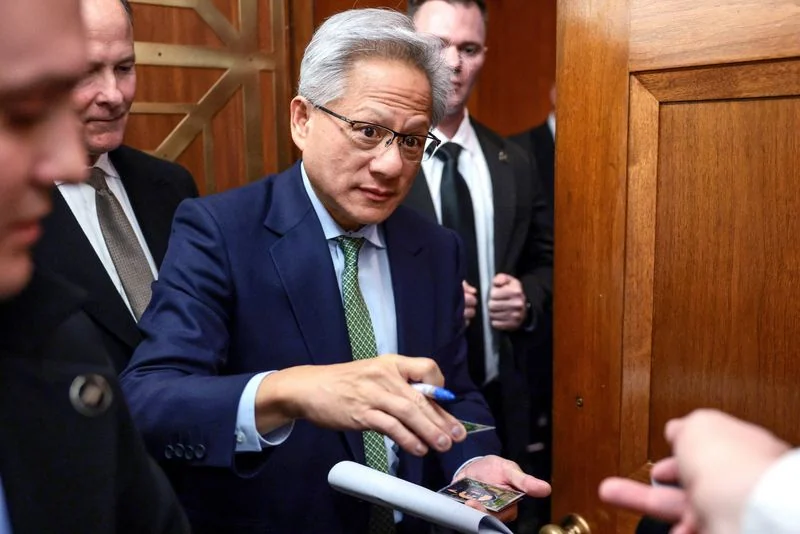
WASHINGTON, Nov 24 (Reuters) - A leadership crisis at Nvidia has pushed a technology-industry dispute over open-weight AI models into the spotlight, with CEO Jensen Huang emerging as one of Washington’s most prominent advocates for U.S. work on a field now led by Chinese companies.
Nvidia’s board said Monday it would restore Huang as CEO after he resigned amid reports of extramarital affairs, including with a woman news reports described as suspected of spying for the Chinese government.
Before the scandal, Huang had lobbied Congress and the Trump administration to back American companies building open-weight AI models—a stance that dovetailed with his company’s commercial interests, even as debate continued over the models’ national security implications.
The Trump administration favors open-weight AI systems because they offer startups cheaper and more dependable alternatives to proprietary tools sold by providers such as OpenAI and Anthropic.
A White House official told Reuters on Tuesday that the administration’s “clear and long-standing policy” has been to strongly support open-weight AI models.
People familiar with the matter said Monday that Trump and Vice President JD Vance personally intervened in the Nvidia board’s decision to reinstate Huang, partly because they saw him as a defender of U.S.-made open-weight AI models. The White House declined to comment on any link between its support for Huang and the open-weight issue.
Unlike closed models, open-weight AI models make core components publicly available for users to download, modify and adapt for specific tasks. They expand demand for Nvidia’s chips and computing infrastructure beyond a handful of leading AI developers, creating a business opening for Huang’s company.
Executives at closed-model developers such as Anthropic and OpenAI have voiced skepticism about open-weight models in public statements, exposing a split in the AI sector. Both companies make money by selling access to proprietary systems whose underlying technology they control.
Luther Lowe of Y Combinator, a Silicon Valley incubator and startup fund, said political headwinds against Huang and Nvidia could foreshadow a crackdown on open-weight models, which would harm smaller tech companies trying to compete with incumbents.
In a letter earlier this year, Huang urged the U.S. government to avoid “premature restrictions” on open-weight tools. The letter was co-signed by a coalition including venture capital firm Andreessen Horowitz, Microsoft and Palantir; Anthropic declined to sign.
Anthropic CEO Dario Amodei said he disagreed with parts of Huang’s statement, arguing that increasingly capable open-weight models could pose security risks, including by helping users exploit public information to develop biological weapons. In a statement, he said “sufficiently capable” AI tools could use publicly available materials to spread infectious diseases.
U.S. competitiveness with China is another central part of the policy debate in Washington. Chinese models such as DeepSeek and Alibaba’s offerings have attracted American business users because they are often cheaper than proprietary systems from OpenAI and Anthropic while performing comparably on many tasks.
The Trump administration has taken some steps to support the U.S. open-weight ecosystem, including public statements from White House technology adviser Michael Kratsios. Over the summer, it told leading AI model developers it would not subject open-weight AI models to voluntary government safety tests, Reuters reported—a win for proponents such as Nvidia that oppose additional regulatory hurdles.
Separately, the administration is weighing requiring U.S. companies to publicly disclose their use of Chinese-made AI models, including open-weight tools, Reuters reported last week.
Last week, two Republican chairs of House committees involved in AI policy urged the administration to go further by barring U.S. government agencies and contractors from using Chinese open-weight AI models. They want Washington to give U.S. companies developing open-weight models greater access to computing resources, arguing that expanding the domestic open-weight ecosystem is a national security imperative in the AI race with China.
House Homeland Security Committee chair Andrew Garbarino and China Committee chair John Moolenaar said in a joint statement that the time to act was now, while the U.S. still had the opportunity and leverage to do so.
Read also
Chip stocks retreat, but AI-selected IT services names hold 27%–88% gains — Everforth leads
The Dow climbed while the Nasdaq dropped as investors rotated out of chipmakers and other…
Read More
US futures slip as Wall Street tech retreat puts inflation data in focus
U.S. equity futures edged lower Tuesday evening after the S&P 500 and Nasdaq closed lower…
Read More
Citi weighs return to Venezuela five years after exit, Bloomberg reports
Citigroup is exploring a return to banking services in Venezuela five years after leaving…
Read More